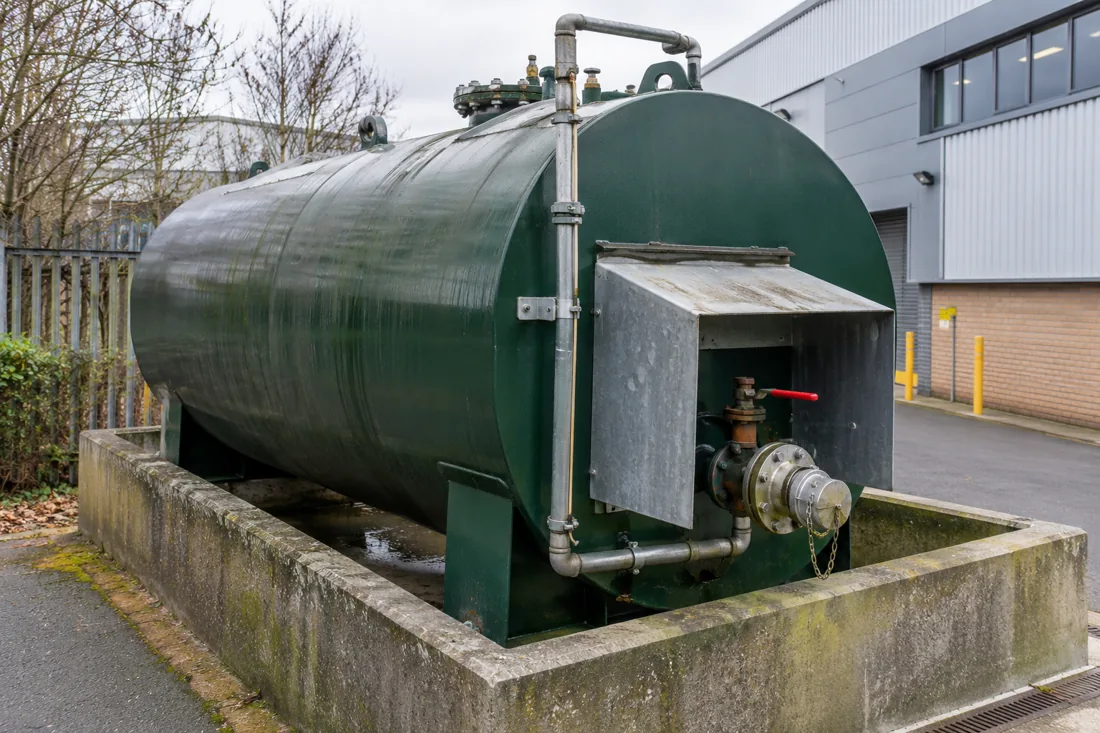
Define What “Out Of Service” Means
A tank that no longer supplies equipment is not automatically decommissioned. Fuel can remain beneath the outlet, pipework can still connect it to another system and an old fill point can accept an unintended delivery. Closing the project means dealing with those risks and documenting the outcome.
Decommissioning is appropriate after a heating conversion, generator replacement, lease change or redevelopment decision. Start by saying whether the storage is permanently redundant or might be needed again. A permanent closure plan should not be used as a substitute for a monitored temporary shutdown.
For a property transaction, a vague reference to an “old tank” leaves questions unanswered. Establish its location, construction, previous contents and any known leak history. Surveyors and future contractors need to understand what remains beneath or within the property.
Match The End State To The Property
| Intended Outcome | Questions To Resolve |
|---|---|
| Remove the redundant installation | Can the tank and pipework be accessed and taken out without unacceptable disruption? |
| Leave a buried tank permanently closed | Why must it remain, what preparation and filling method are suitable, and what future ground use is proposed? |
| Suspend use with possible future return | Who owns monitoring and maintenance, and what checks would be needed before reuse? |
For redundant underground storage, Environment Agency guidance favours removal of tanks and pipework unlikely to be used again. Where a tank has to remain, the preparation and closure method need assessment. The physical constraints should be recorded rather than allowing convenience alone to decide the outcome.
Separate Closure From Continuing Operations
A redundant tank may share a yard, pipe trench or plant room with equipment that is staying. Identify the live assets before work begins, including supply lines, returns, transfer pumps and fill connections. Drawings are useful, but uncertain or unlabelled connections should be investigated by competent personnel.
The scope should define the boundary of isolation and the condition in which each remaining connection will be left. Removing or permanently securing obsolete fill arrangements helps prevent later confusion. Update the site asset record so an old delivery instruction does not survive the project.
Where a replacement tank takes over the load, set a specific acceptance point before closing the old arrangement. Fuel continuity depends on the whole changeover programme, including commissioning and operational responsibility. It cannot be promised from the tank closure work alone.
Old Contents Need A Plan
Long-unused tanks may hold a mixture of fuel, water and settled material even when the gauge reads low. Give the last known contents and delivery history. Unknown liquids should be treated as an assessment issue, rather than described as harmless rainwater.
The contractor needs to establish how liquids will be recovered, whether any product is suitable for retention and where residues will go. A larger remaining volume can alter the vehicle, temporary storage and collection arrangements. Waste classification determines the correct documents and authorised destination.
Cleaning and atmospheric assessment must suit the next task. A tank being cut, entered or filled may require different controls from one awaiting further investigation. Do not commission another trade to start cutting simply because the fuel has been pumped away.
Information For A Closure Survey
Send photographs showing the tank, visible pipework, fill point and surrounding ground. Include the route from the road, overhead restrictions, manhole locations and any existing tank plan. State whether the capacity and material are confirmed or estimated.
For underground storage, explain what lies above and nearby. Vehicle loading, foundations, active services and future excavation all affect the options. If there are stained surfaces, unexplained fuel losses or past spill reports, provide those records at the outset.
The survey also needs a commercial end point. Is the aim to hand a unit back to a landlord, release a construction area or remove a tank from an asset register? Agree who accepts the completed condition and whether another consultant needs to witness or review the work.
Compare Complete Scopes
Preparation, remaining contents, access, cleaning and disposal form the core cost drivers. Excavation, ground testing, filling material or sectional removal can add separate work packages. Restricted operating hours and the need to protect adjacent live plant may change the programme.
Compare quotations against the same end state. A price for emptying alone is not comparable with permanent closure, removal of pipework and reinstatement. Ask what happens if unexpected liquids, damaged pipework or signs of leakage are found, and how any additional work will be authorised.
Leave A Record Future Contractors Can Use
For a tank left in place, retain its capacity, former product, decommissioning method and date. Add a location plan, photographs and the agreed completion record. These details should remain with the property information rather than only in an individual project manager’s inbox.
Waste records and any relevant test or filling records serve different purposes. None of them alone confirms that surrounding ground is uncontaminated. If pollution is suspected, a separate environmental investigation may be needed before the redevelopment or property handover proceeds.
Official guidance: Environment Agency underground tank decommissioning.
Your Questions
Is draining enough to decommission a tank?
Tank decommissioning needs more than draining because residues, vapours and connected pipework may remain. The required preparation depends on whether the tank will be removed, filled or temporarily taken out of use. A competent assessment should define the safe end state and the completion record before work starts.
Does decommissioning prove the ground is clean?
Tank decommissioning does not prove that surrounding ground is free from contamination. A past leak may have affected soil or groundwater outside the installation. If there are signs of pollution, the scope should address investigation separately, with appropriate environmental advice rather than relying on a tank closure record.